


If you’re ready to discover how AI can accelerate your product design workflow without losing its soul, let’s talk.
The most valuable AI skill in 2026 is judgment: the ability to decide what is worth building, what output you can trust and what you should ignore.
Not just prompt writing. Not just coding. Not just knowing the newest AI tool.
Judgment.
That may sound simple, but it is the skill separating companies that get real value from AI from companies that spend months testing tools without changing how the business actually works.
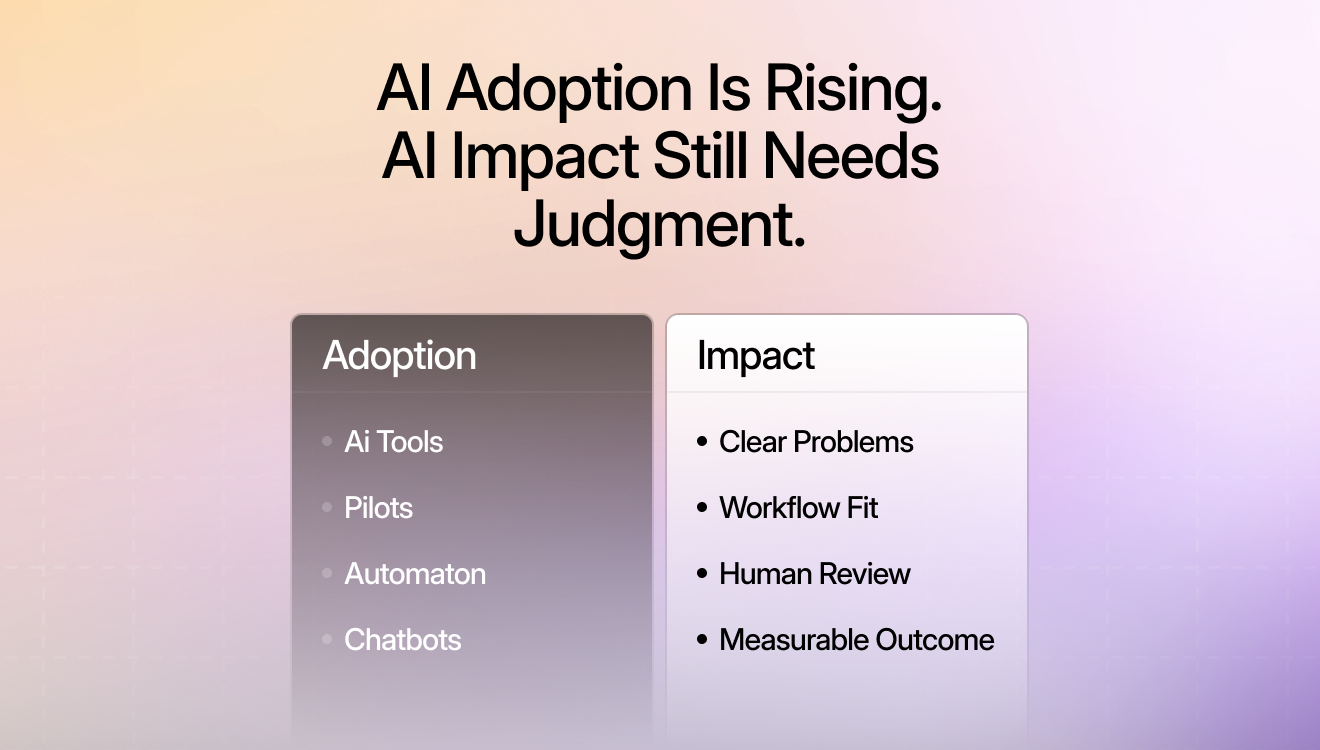
We see this pattern often with businesses exploring AI. They have tools. They have subscriptions. Someone has tested automation. Someone has built a chatbot. The activity is there, but the business outcome is missing.
The problem is rarely access to AI.
The problem is knowing where AI should actually be used.
Everyone Is Learning the Wrong AI Skill First
Search for “AI skills in demand” or “AI skills 2026” and most articles will point you toward the same things:
- Prompt engineering
- Workflow automation
- AI agents
- RAG
- AI chatbot development
- AI coding tools
- AI video and image generation
None of these are useless. Many of them are valuable.
Upwork’s 2026 In-Demand Skills report shows that skills explicitly tied to applying AI inside existing work grew 109% year over year. AI integration grew 178%, AI video generation and editing grew 329%, and AI chatbot development grew 71%. That proves businesses are investing in practical AI skills, not just research or experimentation. Source: Upwork
But there is a deeper issue.
Companies can learn the tools and still fail to get results.
They can know how to prompt and still build the wrong workflow.
They can create an AI chatbot and still have poor customer experience.
They can automate a task and still fail to measure whether it saved time or improved revenue.
That is why the most important AI skill is not simply using the tool. It is knowing how to apply the tool to a real business problem.
Why Judgment Matters More Than Prompting
Prompting is useful, but prompting alone is not a long-term advantage.
A few years ago, writing the perfect prompt felt like a special skill. Today, AI tools can understand rough instructions, ask follow-up questions, improve prompts and generate structured output from incomplete input.
Basic prompting is becoming a baseline skill.
The same thing is happening with many AI tools. A platform that feels advanced today can become outdated in months. A workflow that required technical setup last year may become a built-in feature next year.
That means tool knowledge can expire quickly.
Judgment does not.
Judgment helps you answer the questions tools cannot answer for you:
- Is this the right problem to solve?
- Is AI the right approach?
- What data does the system need?
- What should stay human?
- What result would prove this is working?
- What risk do we create if the output is wrong?
- Is this worth building now?
These questions decide whether an AI project becomes a business asset or another expensive experiment.
The Data Is Pointing in the Same Direction
This is not only our opinion from client work. The broader AI market is showing the same pattern.
Gartner has said that generative AI will require 80% of the engineering workforce to upskill through 2027. The key point is not that AI removes the need for skilled people. It changes what skilled people must be able to do. Gartner also notes that software engineers will increasingly focus on steering AI agents toward the right context and constraints. Source: Gartner
Computerworld also quoted Gartner director analyst Deepak Seth saying that the most valuable AI skill in 2026 is not coding, it is building trust. He connected future AI talent with governance, accountability and organizational change. Source: Computerworld
That word, trust, matters.
Businesses do not need AI output just to look impressive. They need AI output they can trust enough to use in real workflows.
MIT NANDA’s 2025 GenAI Divide research has also been widely reported for a hard lesson: many enterprise GenAI efforts are not producing measurable business impact. Fortune reported that for 95% of companies in MIT’s dataset, generative AI implementation was falling short, with the core issue tied to learning gaps and poor enterprise integration rather than model quality alone. Source: Fortune
That is the real lesson.
AI does not fail only because the model is weak.
AI often fails because the business problem is unclear, the workflow is not integrated and nobody defines what success should look like.
What AI Judgment Looks Like in Practice
Judgment can sound abstract, so let’s make it practical.
For a business, AI judgment has three parts.
1. Knowing What to Build
Most AI mistakes start before the project begins.
A company gets excited about AI and chooses the most visible use case instead of the most valuable one. They build a chatbot because everyone is talking about chatbots. They add AI to a product because competitors are doing it. They automate something because the tool made it easy.
But easy to build does not mean worth building.
The better question is:
Where is the repetitive, expensive or high-volume work that slows the business down?
That is where AI usually creates real value.
For example:
- A support team spending hours summarizing tickets
- A sales team manually qualifying repetitive leads
- An ecommerce team rewriting hundreds of product descriptions
- An operations team copying data between systems
- A manager building reports from disconnected spreadsheets
- A service business answering the same internal questions every week
These are not always flashy use cases, but they are often where the return is easier to measure.
Before starting any AI project, ask:
- What process are we trying to improve?
- How much time or money does this problem cost?
- Who owns the workflow?
- What does success look like?
- What should happen if AI is wrong?
- Can we measure the result within 30 to 90 days?
This is where strong technical consulting matters. Many AI projects need a sharper brief before they need more development.
2. Directing AI Toward the Right Outcome
Using AI is not the same as directing AI.
Using AI means asking a tool to produce something.
Directing AI means designing how the system should work inside the business.
That includes:
- Choosing the right use case
- Connecting the right data
- Defining the human review step
- Setting rules and guardrails
- Deciding what AI can and cannot do
- Measuring whether the workflow improves
This is where many businesses struggle. They test AI in isolation, but the workflow never connects to the systems where work actually happens.
A real AI system may need to connect with a CRM, ecommerce platform, CMS, helpdesk, internal database, analytics dashboard or custom business application.
That is the difference between a demo and a working solution.
A demo shows that AI can produce output.
A working solution shows that AI can improve a real business process.
When the need is more than a simple tool, a custom AI system can be designed around the company’s actual data, workflows and approval rules.
3. Verifying What AI Produces
The third part of judgment is verification.
This is becoming more important, not less.
AI can produce polished answers quickly. That is useful, but it also creates risk. A wrong answer that sounds confident can move through a team fast if nobody checks it.
Verification means knowing when AI output is accurate, complete and safe to use.
This matters in almost every use case:
- AI-written code still needs review.
- AI-generated content still needs brand and fact checks.
- AI reports still need data validation.
- AI support answers still need quality control.
- AI recommendations still need business context.
- AI agents still need logging, permissions and human oversight.
You cannot fully rely on the system you are checking to be its own final judge.
A person with domain knowledge still has to close the loop.
The companies that trust AI blindly can scale mistakes. The companies that verify AI properly can scale useful work.
The AI Judgment Loop
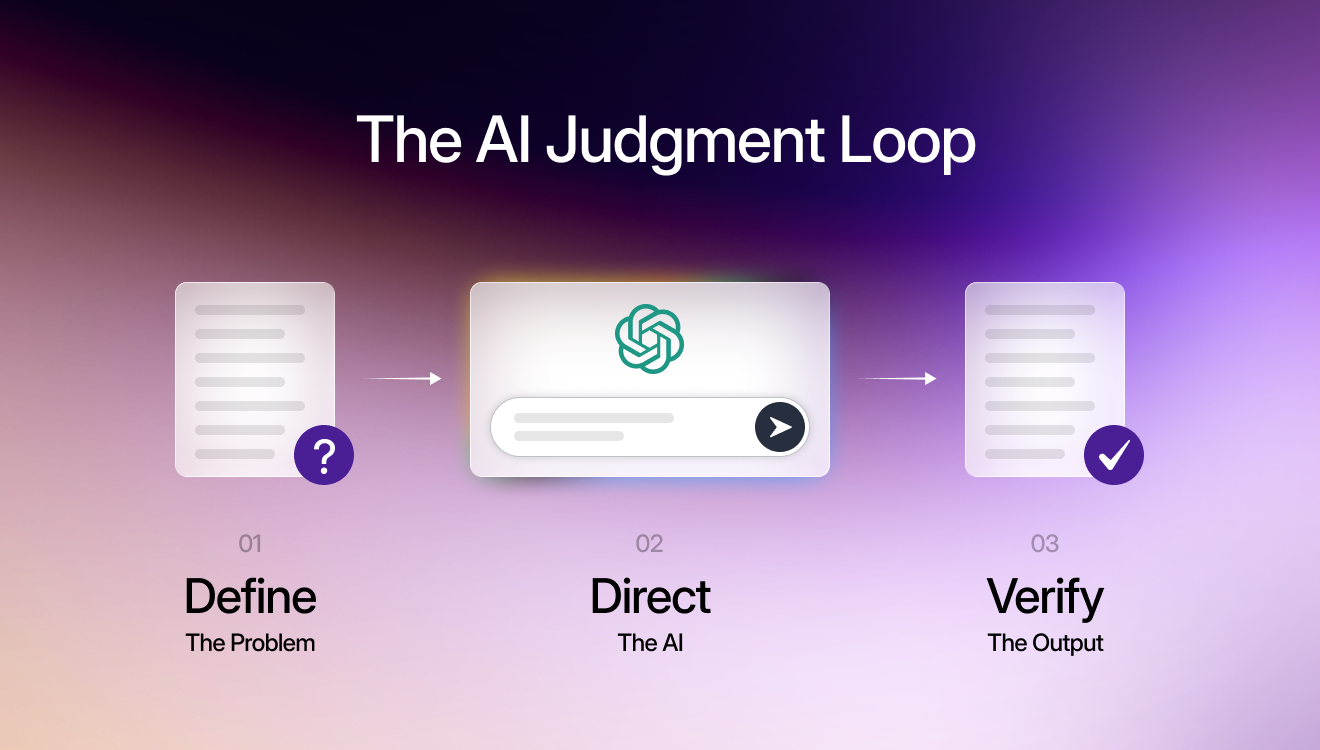
A simple way to understand the skill is this:
Define the problem. Direct the AI. Verify the output.
That is the AI judgment loop.
Most companies focus only on the middle part: getting AI to produce something.
But the real value sits before and after the output.
Before the output, someone must decide what is worth building.
After the output, someone must decide whether it is good enough to use.
The middle part will become easier as tools improve. The first and last parts will become more valuable.
Why This Matters More for Businesses Than Individuals
Most conversations about AI skills are written for individuals who want to stay employable.
That is important, but businesses have a different problem.
Your competitors have access to the same AI tools you do. They can use the same models, buy the same subscriptions and test the same platforms.
The tool itself is not the advantage.
The advantage is how clearly your business understands its workflows, customer problems, data, constraints and outcomes.
Two companies can use the same AI platform and get completely different results.
One company gets another generic chatbot.
The other gets a system that reduces manual work, improves response time or helps teams make better decisions.
The difference is not the model.
The difference is judgment.
Where Businesses Should Start
You do not need to turn your whole team into machine learning engineers.
Start by building the judgment layer.
Pick one repetitive, expensive process in your business. Write down how many hours it costs each week. Then ask whether AI can take a meaningful part of that work without increasing risk.
A good first AI workflow usually has five qualities:
- The process happens often.
- The current work is manual or slow.
- The output can be reviewed by a human.
- The result can be measured.
- The risk of a wrong answer is manageable.
This is a better starting point than asking, “How do we use AI?”
A stronger question is:
“Which business process should AI improve first?”
That question forces the right thinking.
It forces problem definition, workflow design, measurement and verification.
That is where practical AI value starts.
When to Bring in Outside Help
Some AI projects can start with internal teams and existing tools.
But when the workflow involves proprietary data, multiple systems, customer-facing experiences, compliance needs or custom business logic, outside expertise can save time and reduce costly mistakes.
The goal is not to outsource judgment completely.
The goal is to combine your internal business knowledge with technical people who know how to design, build and ship reliable systems.
That is why a hybrid approach often works best.
Your team owns the business problem and domain knowledge. The external team helps with architecture, development, integration, testing and deployment.
For companies that need execution support, team extension can add senior engineering capacity without turning the project into a full internal hiring process.
The best AI partner should not push you to build the most complex thing.
They should help you build the right thing.
Sometimes that means a custom AI workflow.
Sometimes it means better data structure first.
Sometimes it means not building at all yet.
That honesty is part of good AI judgment.
The Skill That Will Still Matter in Five Years
The tools will keep changing.
The model that feels impressive today may feel basic in eighteen months. Prompt engineering may look very different by 2030. More AI capabilities will become built into normal business software.
But judgment will still matter.
Knowing what to build, what to trust and what to ignore is not tied to one platform or one model.
It is the human layer above the tools.
And that layer becomes more valuable as the tools become more powerful.
In five years, simply saying “I can use AI” will not mean much.
The valuable person in the room will be the one who can say:
- This is the right problem.
- This is not worth building.
- This workflow needs human review.
- This output is wrong.
- This result is safe to ship.
- This is how we measure success.
That is the skill worth building.
For yourself.
For your team.
For your business.
Final Thoughts
AI success is not about chasing every new tool.
It is about choosing better problems, building around real workflows and verifying outputs before they affect customers, teams or revenue.
The companies that win with AI will not be the ones that experiment the most. They will be the ones that connect AI to clear business outcomes.
If you are trying to figure out where AI actually fits in your business, start with the brief before the build.
At Webforest, we build custom web platforms, mobile apps and AI systems for businesses that need the work to hold up in the real world. If you are still deciding what is worth building, start with a technical consulting conversation. If you already know the direction and need experienced builders, explore our custom AI development and team extension services.
No hype. No forced AI layer. Just a clearer way to build what actually matters.


 From India


