


If you’re ready to discover how AI can accelerate your product design workflow without losing its soul, let’s talk.
Developers are moving from Next.js to TanStack Start in 2026 primarily because of three compounding frustrations: the App Router’s steep complexity curve, growing concerns about Vercel lock-in, and a string of critical security vulnerabilities in React Server Components. TanStack Start, built by Tanner Linsley, hit v1.0 in early 2026 and offers type-safe routing, isomorphic server functions, and universal deployment without framework magic or platform dependency. It is best suited for interactive SaaS products, dashboards, and client-heavy applications. Next.js still leads for content-heavy and SEO-driven sites. The decision depends on your application type, team’s TypeScript comfort, and appetite for a newer ecosystem.
Introduction: Something Shifted in the React Community
For years, the answer to “what framework should we use?” in a React project was almost automatic: Next.js. It was opinionated enough to save you time, flexible enough not to box you in, and backed by Vercel with a large, mature ecosystem.
That automatic answer is no longer quite so automatic.
In 2026, a growing number of engineering teams, especially those building SaaS products, dashboards, and client-heavy applications, are taking a serious look at TanStack Start. Not because Next.js broke, but because the tradeoffs shifted.
This post breaks down what is actually driving that shift, what TanStack Start does differently, where each framework wins, and how to decide which one fits your next project.
If your team is in the middle of this decision, or if you want a second opinion on your current stack, our technical consulting is built exactly for this kind of architecture question.
What Happened to Next.js?
Next.js did not become a bad framework. It became more complex, and for a specific kind of team, that complexity stopped paying for itself.
The App Router Changed the Mental Model
The shift from the Pages Router to the App Router was not an incremental update. It introduced React Server Components, async components, server actions, and a fundamentally different mental model for how data flows through an application. The two most common reasons teams look at alternatives are Vercel pricing concerns at scale and the App Router’s learning curve and complexity.
For teams with strong React experience, the result was disorienting. The framework they had understood well suddenly required learning a new set of boundaries, rules, and abstractions, with the old patterns either deprecated or working differently than before.
As one developer put it in community discussions: “Next.js lost me with the constant changes and complexity. The benefits do not justify the cognitive overload.”
Vertical Dependency Became a Real Cost Concern
Self-hosting Next.js is technically possible, but features like Incremental Static Regeneration and edge middleware require extra configuration that Vercel’s platform handles automatically. For teams scaling beyond Vercel’s free tier, the pricing math changes, and the decision to use Next.js starts to feel less like a framework choice and more like a platform commitment.
A Security Story That Kept Moving
The security picture added another layer of concern in late 2025 and into 2026. In December 2025, CVE-2025-55182 and CVE-2025-66478 carried a CVSS score of 10.0, the maximum possible severity, representing unauthenticated remote code execution through insecure deserialization in React Server Components. Every Next.js App Router application with server actions was affected, including the default create-next-app scaffold, and it was actively exploited in the wild within days of discovery.
The vulnerabilities were patched quickly, but the pattern of security churn, combined with the architectural complexity, accelerated conversations that were already happening.
What Has TanStack Started?
TanStack Start is a full-stack React framework built by Tanner Linsley, the developer behind TanStack Query (formerly React Query), TanStack Table, and TanStack Router. It offers type-safe file-based routing, server-first ergonomics with isomorphic server functions, built-in streaming, URL-as-state primitives with runtime validation and full type safety, and SSR and SPA developer experience with no lock-in or opaque magic.
TanStack Start hit v1.0 in March 2026, bringing type-safe routing and server functions to production. Built on TanStack Router and Vite, it challenges Next.js with a philosophy developers either love or find unnecessary: explicit control beats framework magic.
It is not a rewrite-everything-in-one-week framework. It is a deliberate alternative for teams who have reached the limits of Next.js’s abstraction model and want more predictability and control. Teams building products that layer custom AI features on top of a React frontend often find TanStack Start’s explicit data flow easier to integrate with AI endpoints and agent workflows than the App Router’s server-action model.
The Real Reasons Developers Are Switching
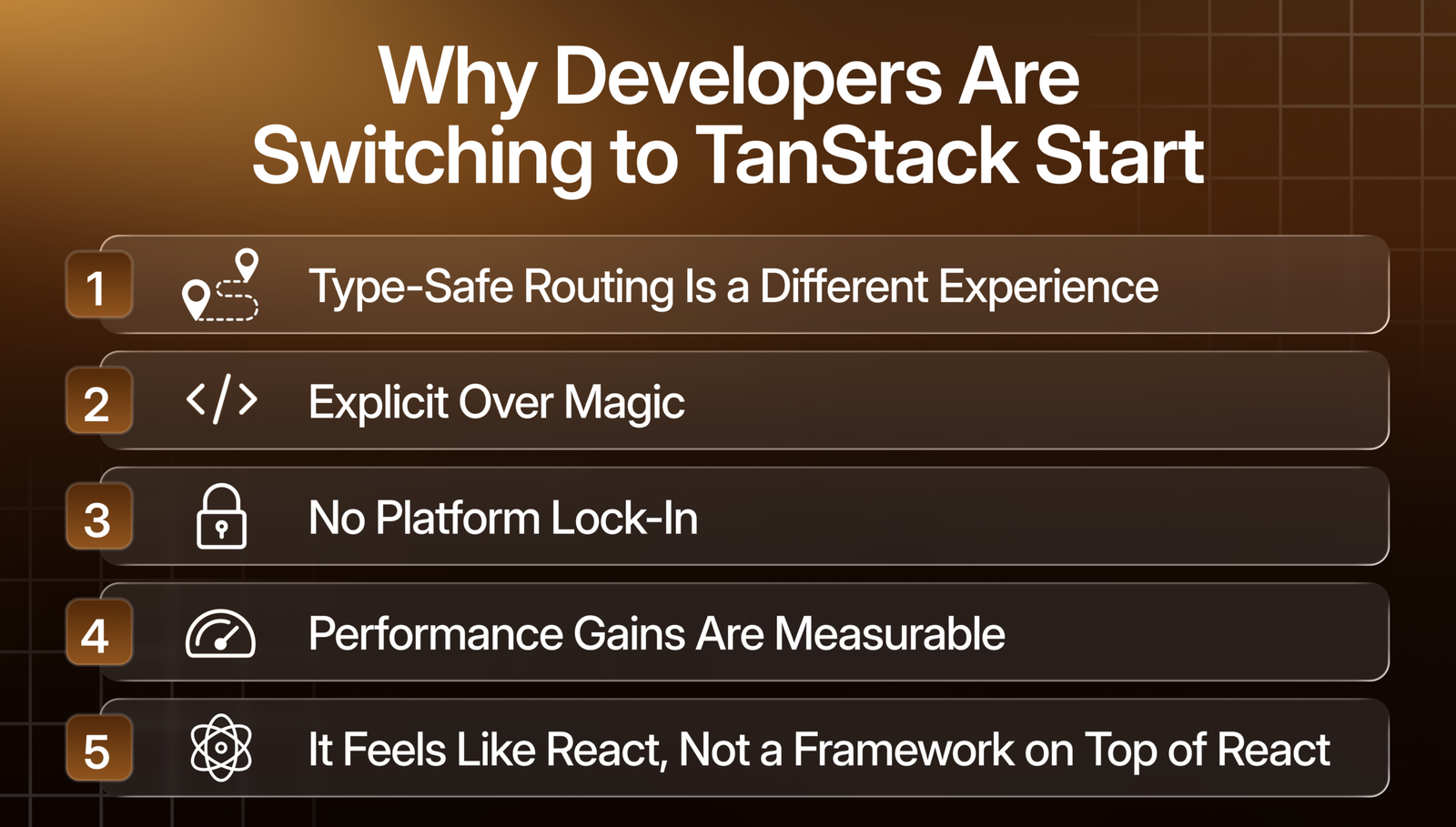
1. Type-Safe Routing Is a Different Experience
Routing turned out to be the single biggest reason developers switch. TanStack Router generates a fully typed route tree at build time. Every route parameter, every search parameter, every loader return type is known to TypeScript without you writing a single type annotation.
In practice, this means entire bug categories disappear. Runtime routing errors that took hours to debug become compile-time catches. As one developer put it: “Type-safe routing alone makes you think differently about what a React framework should provide.”
For teams building SaaS platforms or dashboards where the routing surface area grows rapidly, this is not a minor improvement. It is a structural shift in how much of the debugging burden disappears before the code ships.
2. Explicit Over Magic
When something breaks in a Next.js App Router project, finding the cause can mean tracing through layers of React Server Component boundaries, caching behaviour, and server action conventions. In TanStack Start, the data flow is explicit. You see it, you own it, you can reason about it.
Many developers say TanStack Start lets them scale from side projects to production without losing control or adding complexity. For years, frameworks chased automation and abstractions, trying to do more for the developer. That often came with confusion, slower builds, and less transparency. TanStack’s approach goes the other way.
3. No Platform Lock-In
TanStack Start uses Vite and Nitro, enabling flexible deployment. It works with Netlify, Cloudflare, Vercel, or your own Node server.
This is not a minor detail for teams thinking about infrastructure costs over a multi-year roadmap. The ability to move between hosting providers without framework-level rearchitecting is a meaningful business consideration, not just a developer preference.
This is also one of the reasons teams rebuilding or migrating existing platforms often bring in technical consulting before committing to a new framework. A stack decision made without accounting for deployment flexibility, security posture, and team skillset can cost significantly more to unwind later than it cost to implement.
4. Performance Gains Are Measurable
Real-world tests measured throughput jumping from 427 req/s to 2,357 req/s, a 5.5x improvement, and average latency dropping from 424ms to 43ms, a 9.9x improvement. P99 latency went from 6.5 seconds to 928ms. These numbers came from internal profiling work the TanStack team published in March 2026 after optimising SSR hot paths.
TanStack Start also produces 30-35% smaller client bundles than Next.js.
5. It Feels Like React, Not a Framework on Top of React
Many developers say that once they start using TanStack Start, they forget they are even in a framework. It feels like a normal React with some helpful extras. One Reddit user described it as: “When I first tried it, I thought I was missing something because it was so easy. It just worked.”
That simplicity is meaningful in 2026, where framework fatigue is a real cost. Teams spend real time and real budget managing framework complexity. Reducing cognitive load directly impacts delivery speed.
Not sure which framework fits your product?
Every stack decision has a context: your team size, your application type, your deployment setup, and your two-year roadmap. If you want a senior technical opinion before you commit.
No pitch, just a clear-headed look at your situation.
What TanStack Start Is Actually Best For

TanStack Start shines for startups, indie projects, and teams wanting full control over their stack. More specifically, it is the stronger choice for:
- SaaS dashboards and admin panels where the primary experience is dynamic, interactive, and data-driven
- Internal tools where type safety across the full stack reduces debugging time
- Applications already using TanStack Query where ecosystem consistency reduces the integration surface area
- Teams self-hosting that do not want deployment behaviour tied to a specific cloud platform
- Teams prioritising TypeScript discipline at compile time rather than runtime
If you are building a SaaS product and are evaluating frameworks as part of a wider product architecture decision, our technical consulting team has worked across both stacks in production and can help you map the decision to your specific context.
Where Next.js Still Wins
Being honest matters here. Next.js is not losing ground everywhere.
Next.js remains the stronger choice for:
- Content-heavy sites and marketing platforms where SSG and ISR are core to the architecture, including ecommerce platforms where page-level caching directly impacts conversion speed
- Applications where React Server Components’ zero-bundle-contribution model is genuinely needed
- Teams that rely on the large ecosystem of authentication libraries, CMS integrations, and documented patterns, where a mature plugin and adapter ecosystem matters
- Projects built around SEO services and organic visibility, where Next.js’s static generation and ISR capabilities offer a well-understood path to fast, crawlable pages
- Projects where the hiring pool for framework knowledge is a practical constraint
The State of JS 2025 survey confirmed Next.js at 59% usage among respondents, the dominant meta-framework by a wide margin. The ecosystem advantage is real and should not be dismissed.
What TanStack Start Does Not Have Yet
TanStack Start v1.0 lacks React Server Components support. The team is actively working on integration, but if you need RSC today, you are waiting or choosing Next.js.
TanStack Start’s community is smaller but highly engaged. The documentation is solid and improving. But you will sometimes be the first person to encounter a specific problem, and that requires a different comfort level.
This is not a reason to avoid TanStack Start, but it is a reason to go in with clear expectations. The trajectory matters: TanStack Start’s growth curve in 2025 and 2026 mirrors what Vite’s adoption looked like in 2021 and 2022: rapid uptake among experienced developers, with broader adoption following.
How to Decide: A Practical Framework
Before committing to a migration or a new project decision, work through these questions:
What kind of application are you building? Content-heavy, SEO-driven, or static? Stay with Next.js. Dashboard, SaaS product, or interactive client-side app? TanStack Start is worth a serious evaluation.
How does your team feel about TypeScript discipline? TanStack Start’s compile-time type safety is its biggest strength, but only if the team commits to it. Teams not already using TypeScript strictly may not see the value immediately.
What is your deployment situation? If Vercel is a long-term choice and you are comfortable with its pricing at scale, the lock-in concern is minimal. If you are self-hosting or need deployment flexibility, TanStack Start’s platform-agnostic design is a meaningful advantage.
Are you already in the TanStack ecosystem? If your team already uses TanStack Query for data fetching, the learning curve for TanStack Start is significantly shorter. The ecosystem integrates seamlessly across Query, Router, Table, and Form, bringing end-to-end type safety and consistent patterns across modular tools.
What is your tolerance for a newer ecosystem? TanStack Start is production-ready. But its third-party ecosystem, authentication patterns, and CMS integrations are still developing. Teams that need a known answer for every infrastructure question should either wait or stay with Next.js for now.
If these questions surface real uncertainty, that is usually a signal that the decision deserves a structured technical review before development starts. Our technology strategy consulting service covers exactly this: framework selection, architecture planning, and tech stack decisions grounded in your product’s actual requirements, not trend cycles.
Migration: What to Expect
Migration guides exist for Next.js. Remix and React Router guides are in progress. The migration is not a one-to-one translation. The mental model shift from server-first to client-first means some architectural decisions need revisiting, not just code translation. Expect a meaningful ramp-up period for teams coming from heavy Next.js App Router usage.
For new projects, the starting cost is low. A quick start is available via CLI with npx @tanstack/cli@latest create, and the barrier to entry is low enough to spin up a test project and evaluate whether the type-safe approach fits your team before committing.
The Bigger Picture
This shift is not really about Next.js versus TanStack Start as products. It reflects a maturing conversation about what developer experience means at a production scale.
The question is not which framework is objectively better. The question is which philosophy fits your team’s working style, application type, and infrastructure needs, and which set of tradeoffs you can live with over a two-to-three-year roadmap.
Both frameworks are production-ready. Both have engineering teams actively improving them. The switch that makes sense is the one grounded in your actual constraints, not in following a trend. This applies equally to teams working on conventional SaaS products and to teams building on more specialised architectures, including blockchain-based platforms where the frontend framework decision interacts with wallet integrations, on-chain data fetching, and transaction state management in ways that reward explicit, predictable data flow.
What This Means for Teams Building Products
Framework decisions sit underneath everything: the speed you ship, the bugs you debug, the hosting costs you carry, and the developers you can hire. Making the wrong call is expensive to unwind.
At Webforest, we work across Next.js, TanStack Start, and the broader React ecosystem, building SaaS products, dashboards, web applications, and scalable platforms. The framework decision is always specific to the product, its interaction model, data patterns, team, and infrastructure. We do not have a default answer, because the right choice depends on constraints that most generic guides do not account for.
If your team is weighing a framework decision for a new product or reconsidering an existing stack, the first conversation is always about what you are actually building and who is building it, not which tool is trending. Our technical consulting team works through exactly this kind of decision before a line of code is written.
You can also see the kinds of products and platforms we have built across our work portfolio, which covers SaaS products, dashboards, e-commerce, and custom web applications.



 From India


