


If you’re ready to discover how AI can accelerate your product design workflow without losing its soul, let’s talk.
Most businesses do keyword research the same way.
They open an SEO tool, search for high-volume keywords, check keyword difficulty, export a list, and start writing content.
That process is useful, but there is one big problem.
By the time a keyword shows strong search volume in SEO tools, your competitors may already be targeting it. The search results may already be filled with blogs, landing pages, comparison guides, and paid campaigns.
That means you are not always finding new opportunities. You are often joining a race that has already started.
A smarter approach is to find trending keywords before they become obvious.
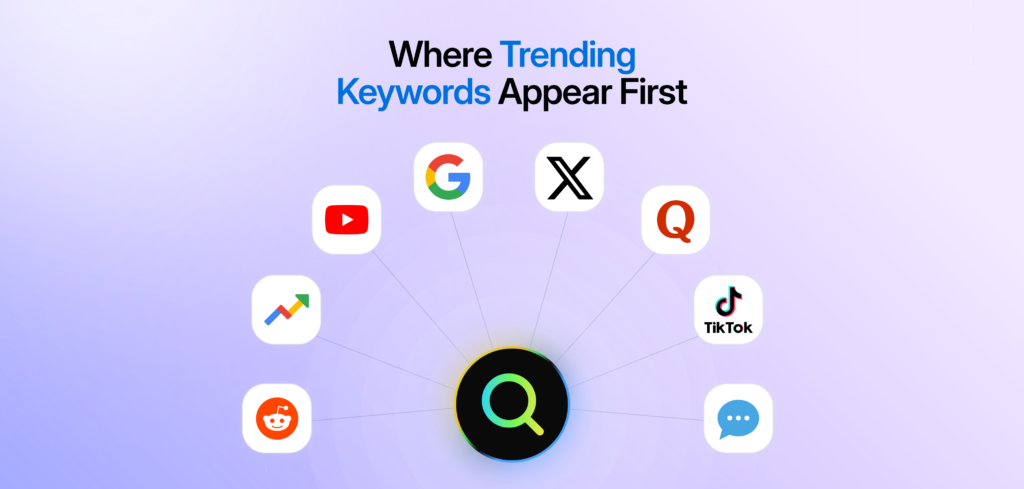
Trending keywords are topics, questions, phrases, and search terms that people are starting to talk about online before SEO tools fully show their demand. These ideas often appear first on platforms like Reddit, TikTok, X, Quora, YouTube, niche forums, Google Trends, and online communities.
For businesses, startups, SaaS companies, service providers, and agencies, this can create a major SEO advantage. You can publish helpful content early, build topical authority faster, and reach people before the competition becomes too strong.
In this guide, we will explain how to find trending keywords, how to validate them, and how to turn them into SEO content that supports visibility, traffic, and business growth.
What Are Trending Keywords?
Trending keywords are search terms or topic ideas that are gaining attention quickly.
They may not always have high search volume yet. In some cases, keyword tools may show very low volume or even zero search volume. But that does not mean people are not interested.
It may simply mean the topic is too new.
For example, before a topic becomes popular in SEO tools, people may already be discussing it on:
- Reddit threads
- TikTok videos
- Quora questions
- X conversations
- YouTube comments
- Niche industry forums
- Product communities
- Slack groups
- Discord channels
- Google Trends
A trending keyword can be:
- A new product name
- A new technology term
- A new customer problem
- A new comparison search
- A new regulation or update
- A new industry phrase
- A new “how to” question
- A new pain point people keep repeating
For example, terms like “AI search optimization,” “Google AI Overview SEO,” “zero-click search,” and “answer engine optimization” started becoming more important as search behavior changed.
Businesses that identified those topics early had the chance to create content before the SERPs became crowded.
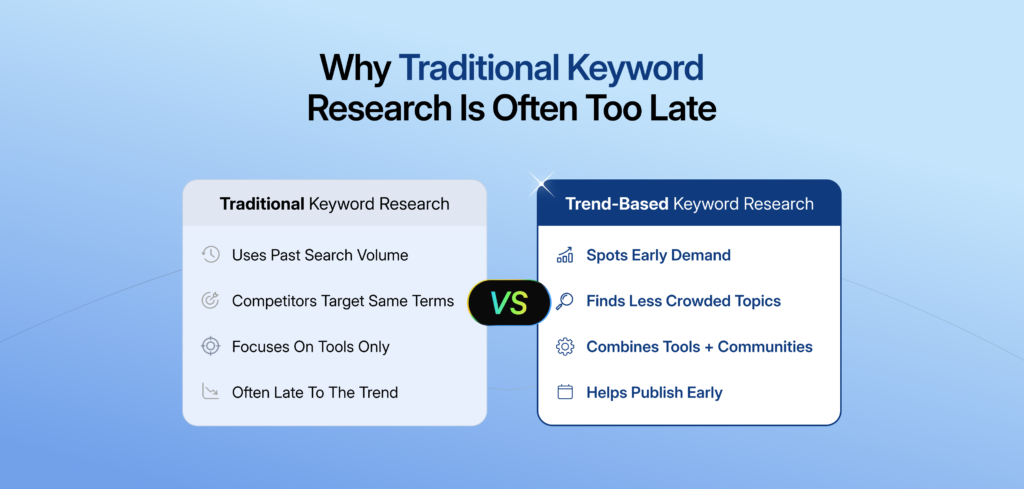
Why Traditional Keyword Research Is Often Too Late
Traditional keyword research is still important. You should not ignore SEO tools.
Tools like Ahrefs, Semrush, Google Keyword Planner, Google Search Console, and Ubersuggest can help you understand volume, difficulty, rankings, and competitor performance.
But relying only on tools can limit your strategy.
Why?
Most keyword tools are based on historical data. They show what people have already searched for. They are not always fast enough to show what people are just starting to care about.
That creates three problems.
First, your competitors are using the same tools. If everyone is looking at the same keyword list, everyone starts targeting the same topics.
Second, high-volume keywords usually have higher competition. The more obvious the keyword, the harder it becomes to rank.
Third, many new opportunities appear outside SEO tools first. People often discuss new problems on Reddit, TikTok, X, Quora, and forums before they search for them heavily on Google.
This is why modern SEO needs more than keyword volume. It needs trend awareness, user behavior research, and content timing.
At Webforest, we see SEO as more than ranking for keywords. A good SEO service connects audience demand, business goals, technical performance, content quality, and conversion strategy. Keyword research is only powerful when it helps you understand what your audience needs before your competitors do.
Why Trending Keywords Matter for SEO
Trending keywords can give you an early-mover advantage.
When you publish helpful content around a topic before it becomes highly competitive, you have a better chance of ranking early and building authority around that subject.
Here is why trending keywords are valuable.
1. They Usually Have Lower Competition
When a topic is still new, fewer websites have covered it properly.
That means you may not need hundreds of backlinks or a massive domain authority score to compete. A well-written, useful, and well-structured article can perform strongly if the SERP is still weak.
2. They Help You Build Topical Authority Early
If your website covers a topic before others, you can create a strong content cluster around it.
For example, if “AI search optimization” is trending, you can create related content such as:
- What is AI search optimization?
- AI SEO vs traditional SEO
- How to optimize content for AI search
- How Google AI Overviews affect SEO
- Best practices for answer engine optimization
This helps search engines understand your expertise around the topic.
3. They Help You Understand Real Audience Pain Points
Trending keyword research is not only about keywords. It is about listening.
When people ask the same question repeatedly on Reddit, Quora, TikTok, or forums, they are showing you a real pain point. That can help you create content that feels useful, timely, and relevant.
4. They Can Bring Qualified Traffic
Some trending keywords may have low volume, but the traffic can be highly targeted.
A person searching for a specific new problem or solution may be closer to taking action than someone searching for a broad beginner keyword.
5. They Support AI Search and Answer-Based Visibility
Search is becoming more answer-driven. People expect direct, useful, and well-structured information.
When your content answers emerging questions clearly, it has a better chance of being useful across search engines, AI search experiences, featured snippets, and People Also Ask results.
How to Find Trending Keywords
How to Find Trending Keywords
Now let’s get practical.
Here are the best ways to find trending keywords before your competitors.
1. Use TikTok Search for Early Topic Signals
TikTok is no longer only an entertainment platform. It is also a discovery engine.
People use TikTok to search for product reviews, tutorials, local businesses, trends, lifestyle advice, tech tips, health topics, beauty routines, finance tips, and more.
To find trending keywords on TikTok:
- Open TikTok search.
- Type a broad keyword from your niche.
- Look at autocomplete suggestions.
- Study video titles and captions.
- Read the comments.
- Notice repeated questions.
- Save phrases people use naturally.
For example, if you are in the skincare niche, TikTok may show phrases like:
- Best serum for oily skin
- Why is my skin barrier damaged?
- Korean sunscreen for acne-prone skin
- Retinol mistakes beginners make
These phrases can become blog topics, FAQ sections, comparison articles, or product landing page ideas.
For B2B industries, TikTok may also reveal early conversations around AI tools, productivity software, automation, startup operations, hiring, design trends, and marketing strategies.
The key is not to copy trends blindly. Look for repeated demand.
If many people are asking similar questions, it may be worth validating for SEO.
2. Use X to Spot Fast-Moving Conversations
X is useful for finding early conversations in technology, SaaS, startups, marketing, finance, AI, software development, and business strategy.
Many industry experts, founders, marketers, developers, and creators discuss new problems on X before those topics become mainstream search terms.
To use X for keyword research:
- Search your niche keyword.
- Follow industry experts.
- Track repeated phrases.
- Look for questions in replies.
- Study popular threads.
- Watch for new terminology.
- Save phrases people use again and again.
For example, in digital marketing, you might see discussions around:
- AI search traffic loss
- SEO for AI Overviews
- Google ranking volatility
- programmatic SEO
- content decay
- topical authority
- zero-click searches
Each of these can become a keyword cluster.
X is especially helpful when your niche changes quickly.
3. Use Reddit for Real Pain-Point Keywords
Reddit is one of the best platforms for finding real user language.
People are honest on Reddit. They ask detailed questions, share frustrations, compare tools, explain problems, and discuss what has worked or failed for them.
This makes Reddit extremely useful for SEO keyword research.
To find keyword ideas from Reddit, search:
site:reddit.com your niche problem
site:reddit.com your niche “how do I”
site:reddit.com your niche “best”
site:reddit.com your niche “vs”
site:reddit.com your niche “worth it”
You can also search directly inside relevant subreddits.
Look for:
- Repeated beginner questions
- Common complaints
- Product comparisons
- “Is it worth it?” questions
- Tool recommendations
- Mistakes people mention
- Problems people cannot solve
- Terms people use naturally
For example, if you offer SEO services, Reddit can reveal questions like:
- Why is my website not ranking?
- How long does SEO take?
- Is SEO still worth it?
- How do I find low competition keywords?
- Should I write blogs or landing pages?
- Why is my traffic dropping after the Google update?
These are not just keyword ideas. They are content opportunities.
If your blog answers these questions better than competitors, you can attract readers who are actively looking for help.
4. Use Quora for Question-Based Keywords
Quora is useful because it shows how people phrase questions.
Many Quora questions are close to actual Google searches. This makes it a strong source for FAQ ideas, beginner-friendly blog topics, and long-tail keywords.
To use Quora:
- Search your main topic.
- Open related questions.
- Check questions with many answers or followers.
- Save repeated question patterns.
- Convert those questions into H2s or FAQs.
Examples:
- How do I choose the right SEO keywords?
- What is the best way to find trending topics?
- How can small businesses compete in SEO?
- Are low-volume keywords worth targeting?
- How do I know if a keyword is too competitive?
Quora is especially helpful when writing educational content for beginners.
If your audience is mixed, meaning both beginners and experts, Quora helps you simplify the topic without making it shallow.
5. Use Niche Forums to Find Keywords SEO Tools Miss
Niche forums are underrated.
In many industries, the best keyword ideas do not start in SEO tools. They start in communities where real users talk to each other.
To find forums, search Google:
your niche + forum
your niche + community
your niche + discussion
your niche + help
your niche + questions
Niche forums are useful for industries like:
- SaaS
- Healthcare
- Legal
- Finance
- Real estate
- Automotive
- Gaming
- Fitness
- Parenting
- Travel
- Software development
- Home improvement
Look for thread titles. They often contain keyword ideas.
For example:
- “Best CRM for small sales team?”
- “Why does my Shopify store load slowly?”
- “Is custom software better than SaaS?”
- “How do I automate client onboarding?”
- “Which framework is best for MVP development?”
For a company like Webforest, niche forums can reveal what business owners, startups, and agencies are struggling with before they search for professional help.
That insight can guide SEO blogs, service page improvements, landing page copy, and lead-generation content.
6. Use Google Trends to Validate Momentum
Google Trends helps you understand whether a topic is rising, falling, seasonal, or stable.
This is important because not every social trend deserves SEO content.
Some topics spike for a few days and disappear. Others grow slowly and become long-term search opportunities.
Use Google Trends to check:
- Is interest increasing?
- Is the topic seasonal?
- Which regions are searching?
- What related queries are rising?
- Are there breakout terms?
- Is the trend stable over time?
A smart approach is to compare topics.
For example, instead of only checking “AI SEO,” compare:
- AI SEO
- answer engine optimization
- AI search optimization
- Google AI Overviews SEO
This helps you choose the strongest angle.
Google Trends is not perfect, but it gives useful directional data.
7. Use Exploding Topics to Find Growing Ideas
Exploding Topics is useful for finding growing trends before they become mainstream.
You can use it to search topics by category and identify ideas that are gaining traction.
For SEO strategy, it can help you:
- Discover emerging topics
- Find related terms
- Spot early industry shifts
- Validate if a topic is growing
- Build content before the competition increases
For example, if you work in AI, SaaS, eCommerce, or digital marketing, trend tools can show topics that are gaining interest before traditional keyword tools show full volume.
Use these trends as seed ideas. Then, validate them using Google Trends, Reddit, Quora, SERP analysis, and keyword tools.
8. Use YouTube Autocomplete and Comments
YouTube is another powerful search engine.
People use YouTube for tutorials, reviews, comparisons, product demos, and problem-solving.
To find keyword ideas:
- Search your broad topic on YouTube.
- Check autocomplete suggestions.
- Review top video titles.
- Read comments.
- Look for questions people ask repeatedly.
- Turn those questions into blog sections.
YouTube is especially useful for keywords starting with:
- How to
- Best
- Review
- Tutorial
- Mistakes
- Comparison
- Beginner guide
- Step-by-step
For example:
- How to create an SEO strategy
- Best AI tools for small businesses
- Website redesign mistakes
- CRM automation tutorial
- How to improve website conversion rate
These can become educational blog posts, service page FAQs, or lead magnet ideas.
How to Find Trending Keywords in a Niche
Finding general trending keywords is useful, but niche-specific keywords are usually more valuable.
A broad trend may bring traffic, but a niche trend can bring the right audience.
Here is a simple process.
Step 1: Start with a Seed Topic
Choose a broad topic related to your business.
Examples:
- SEO
- AI development
- CRM software
- UI/UX design
- eCommerce development
- mobile app development
- website redesign
- digital marketing
- automation
Step 2: Search the Topic Across Platforms
Search the same topic on:
- TikTok
- Quora
- X
- YouTube
- Forums
- Google Trends
Step 3: Collect Repeated Questions
Do not save every idea.
Save only the questions or phrases you see repeatedly.
Repeated phrases show demand.
Step 4: Group Ideas by Intent
Group your ideas into categories:
- Informational intent
- Commercial intent
- Comparison intent
- Problem-solving intent
- Beginner intent
- Advanced intent
For example:
Informational:
“What is AI search optimization?”
Comparison:
“AI SEO vs traditional SEO”
Problem-solving:
“Why is my organic traffic dropping?”
Commercial:
“Best SEO agency for SaaS startups”
Step 5: Validate the Topic
Before writing, check:
- Google Trends
- Google autocomplete
- People Also Ask
- Keyword tool data
- SERP competition
- Competitor content gaps
- Business relevance
This helps you avoid writing about trends that are popular but not useful for your business.
For companies that want to build smarter internal systems for research, reporting, or content planning, custom AI development can help turn scattered data into usable insights.
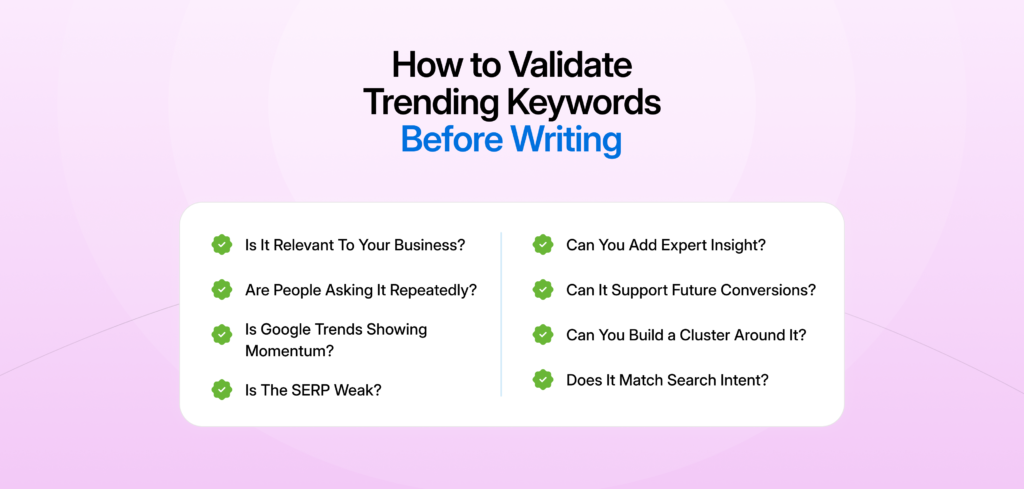
How to Validate Trending Keywords Before Writing
How to Validate Trending Keywords Before Writing
Not every trending keyword is worth targeting.
Some trends are too short-lived. Some bring the wrong audience. Some are interesting but do not connect to your business.
Before writing, use this checklist.
1. Is the Topic Relevant to Your Business?
A keyword should support your business goals.
For example, if you are a software development agency, a trending topic around “AI automation for customer support” may be relevant.
But a random viral trend with no connection to your services may not help.
2. Are People Asking the Same Question Repeatedly?
One post is not enough.
Look for repeated demand across different platforms.
If the same question appears on Reddit, Quora, TikTok, and Google autocomplete, it is more likely to be valuable.
3. Is the SERP Weak?
Search the keyword on Google.
Check what is ranking.
Ask:
- Are the top pages outdated?
- Are they too generic?
- Are they missing examples?
- Are they missing expert insight?
- Are they thin or poorly structured?
- Can you create something better?
If yes, you may have an opportunity.
4. Can You Add Real Expertise?
This is very important.
Do not publish trend content just to chase traffic. Add experience, examples, frameworks, checklists, and practical guidance.
Expert content performs better because it is more useful.
5. Can the Topic Convert Later?
Some keywords are informational, but they can still support future conversions.
For example:
“How to find trending keywords” may not directly convert immediately. But it can attract business owners and marketers who may later need SEO strategy, content planning, or digital marketing support.
That makes it valuable for a company like Webforest.
6. Can You Build a Cluster Around It?
A strong trending keyword should lead to more content ideas.
If one topic can become five or ten related articles, it may help build topical authority.
What Are Zero Search Volume Keywords?
Zero search volume keywords are keywords that show little or no monthly search volume in SEO tools.
Many people ignore them.
That can be a mistake.
A keyword may show zero volume because:
- The topic is new
- The phrase is very specific
- The tool has not collected enough data
- The search demand is emerging
- The keyword is long-tail
- People use different variations
For example, a new AI tool, a new Google update, a new SaaS feature, or a new customer problem may not show volume immediately.
But if people are discussing it actively, it may still be worth targeting.
The best way to judge zero-volume keywords is not by tool data alone. Ask:
- Are real people asking this?
- Is the topic growing?
- Is it relevant to my business?
- Can I answer it better than others?
- Does it connect to a service, product, or content cluster?
For many businesses, zero-volume keywords can bring highly qualified visitors because the search is specific.
How to Select Keywords That Can Actually Drive Results
Finding keywords is easy. Selecting the right ones is where strategy matters.
Use these filters before choosing a trending keyword.
Business Relevance
Will this keyword attract people who may need your product or service?
For example, “how to find trending keywords” is relevant for WebForest because it connects to SEO strategy, content marketing, digital growth, and business visibility.
Search Intent
What does the user want?
Do they want to learn, compare, buy, solve a problem, or hire someone?
Your content format should match the intent.
Competition Level
Can your website realistically compete?
If the SERP is dominated by major authority sites, you may need a more specific long-tail angle.
Content Depth
Can you create a better page than what already exists?
Better means:
- Clearer explanation
- Better examples
- More practical steps
- Stronger structure
- Updated information
- Better FAQs
- Better visuals
- Better internal linking
Conversion Potential
Will the keyword support your business funnel?
Some keywords bring awareness. Others bring leads. A balanced SEO strategy needs both.
Cluster Potential
Can this keyword support related content?
A single blog is useful, but a full content cluster is stronger.
How to Find Competitors’ Keywords and Spot Gaps
Competitor keyword research is useful, but it should not be your only strategy.
If you only copy competitor keywords, you are always behind.
Instead, use competitor research to understand what they already cover, then use trend research to find what they missed.
Here is how.
Step 1: Identify Your SEO Competitors
Your SEO competitors are not always your business competitors.
They are the websites ranking for the keywords you want.
Search for your target keywords and list the websites that appear repeatedly.
Step 2: Check Their Top Pages
Use SEO tools to see which pages bring them traffic.
Look for:
- Blog topics
- Service pages
- Comparison pages
- Guides
- Resource pages
- FAQs
Step 3: Find Missing Subtopics
Ask:
- What questions did they not answer?
- Is their content outdated?
- Did they ignore beginner-level explanations?
- Did they miss expert-level depth?
- Are there no examples?
- Are there no clear next steps?
- Are their FAQs weak?
Step 4: Add the Trending Layer
Now compare competitor content with what people are discussing on Reddit, TikTok, X, Quora, and forums.
This is where you find gaps competitors have not noticed yet.
That is your opportunity.
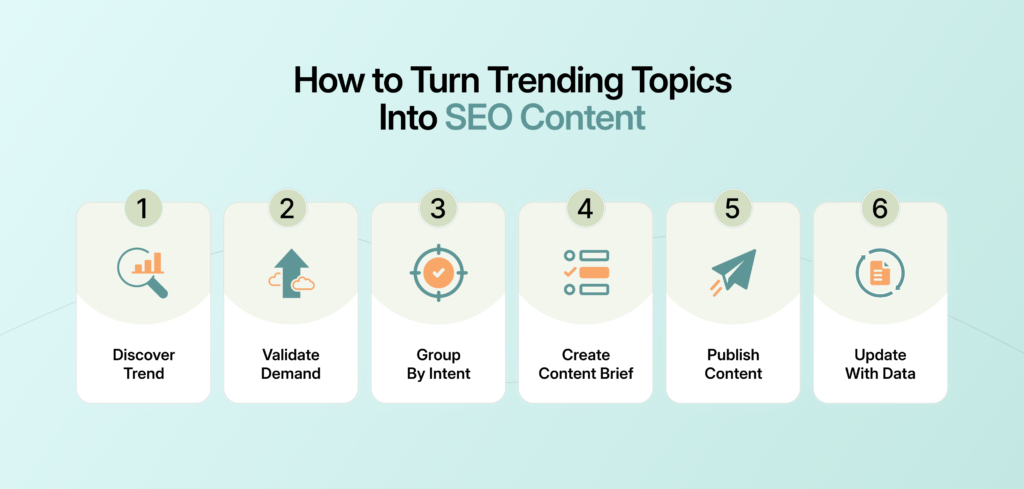
How to Turn Trending Topics Into SEO Content
How to Turn Trending Topics Into SEO Content
A trending topic is not automatically a keyword strategy.
You need to turn it into useful content.
Here is a simple framework.
Step 1: Capture the Trend
Example trend:
“AI search optimization”
Step 2: Find Related Questions
Questions may include:
- What is AI search optimization?
- How is AI search different from traditional SEO?
- How do I optimize content for AI Overviews?
- Will AI search reduce website traffic?
- How should businesses change their SEO strategy?
Step 3: Create Keyword Variations
Possible keywords:
- AI search optimization
- AI SEO strategy
- How to optimize for AI search
- SEO for AI Overviews
- AI search vs traditional SEO
- answer engine optimization
Step 4: Choose the Best Content Format
Depending on intent, create:
- Blog guide
- Checklist
- Comparison article
- FAQ page
- Landing page
- Case study
- Tool page
- Glossary page
Step 5: Add Internal Links
Connect the new content to related pages.
Example: For WebForest, this could include internal links to:
Internal linking helps users move from education to action naturally.
Step 6: Add a Helpful CTA
Do not push too hard in informational blogs.
Use a soft CTA like:
Need help turning keyword ideas into a practical SEO content plan?WebForest can help you identify the right opportunities, build a clear strategy, and create content that supports long-term visibility.
This feels natural because it connects directly to the reader’s problem.
Best Tools to Find Trending Keywords
You do not need dozens of tools. You need the right mix.
Here are the most useful options.
Google Trends
Best for checking search momentum and seasonal interest.
Best for pain points, complaints, comparisons, and real user language.
Quora
Best for question-based keywords and FAQ ideas.
TikTok Search
Best for fast-moving consumer trends and simple language patterns.
X
Best for real-time industry conversations and expert discussions.
YouTube Autocomplete
Best for tutorials, reviews, comparisons, and “how-to” keywords.
Exploding Topics
Best for discovering growing topics before they become mainstream.
Google Autocomplete
Best for finding search patterns directly from Google.
People Also Ask
Best for understanding related questions.
Google Search Console
Best for finding impressions from keywords you are already starting to appear for.
Ahrefs or Semrush
Best for keyword validation, competitor research, and SERP analysis.
The best strategy is to combine tools with human research.
SEO tools show data. Communities show demand. Your job is to connect both.
Common Mistakes to Avoid
Trending keyword research can be powerful, but only if you use it carefully.
Avoid these mistakes.
Chasing Every Trend
Not every trend is useful.
Focus on trends connected to your audience, services, and business goals.
Ignoring Search Intent
A keyword may look good, but if the intent does not match your content, it will not perform well.
Publishing Thin Content
Do not write a short article just because a topic is trending.
Create something genuinely useful.
Ignoring Zero-Volume Keywords
Some low-volume or zero-volume keywords can become valuable if the topic is emerging.
Copying Competitors Only
Competitor research shows what already exists. Trend research shows what may come next.
You need both.
Not Updating Content
Trending content should be updated as the topic matures.
When search volume grows, competitors enter, or new information appears, improve your article.
Not Adding CTAs
Informational content should still guide the reader.
A CTA does not always need to sell. It can invite readers to explore a service, request help, or start a strategy conversation.
A Weekly Workflow for Trend-Based Keyword Research
Here is a simple workflow businesses can follow every week.
Monday: Check Social and Community Signals
Review:
- TikTok
- Quora
- X
- YouTube
- Forums
Save repeated questions and phrases.
Tuesday: Validate Topics
Check:
- Google Trends
- Google autocomplete
- People Also Ask
- Keyword tools
- SERP quality
Shortlist the strongest ideas.
Wednesday: Group Keywords by Intent
Separate ideas into:
- Informational
- Commercial
- Comparison
- Problem-solving
- Beginner
- Advanced
This helps you choose the right content format.
Thursday: Create the Content Brief
Include:
- Primary keyword
- Secondary keywords
- Search intent
- H2 structure
- FAQs
- Internal links
- CTA
- Expert points
- Examples
Friday: Publish or Update Content
Create one strong piece of content instead of five thin ones.
After publishing, track performance in Google Search Console.
Look for:
- Impressions
- Clicks
- Query variations
- Ranking movement
- New keyword opportunities
Then update the blog as more data appears.
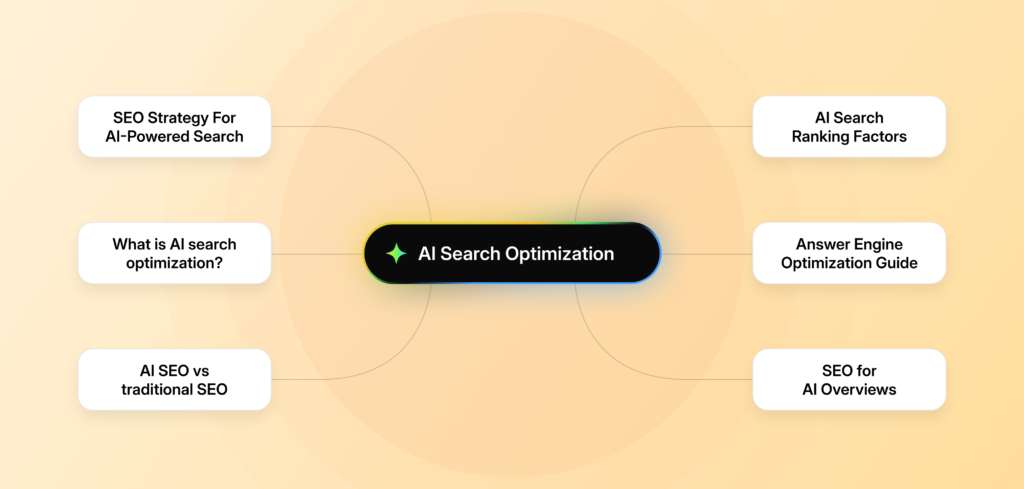
Example: Turning One Trend Into a Content Cluster
AI Search Optimization
Let’s say you notice people discussing “AI search optimization.”
Instead of writing one small blog, build a cluster.
What Is AI Search Optimization?
Supporting Blogs
- How to Optimize Content for AI Search
- AI SEO vs Traditional SEO
- How Google AI Overviews Affect Organic Traffic
- Answer Engine Optimization Guide
- AI Search Ranking Factors
- SEO Strategy for AI-Powered Search
- How Businesses Should Adapt Their SEO Strategy for AI Search
Service Connection
This cluster can naturally connect to:
- SEO services
- AI development
- Technical consulting
- Content strategy
- Website optimization
This is how trend-based keyword research becomes a business asset, not just a blog idea.
How Businesses Can Use Trending Keywords Beyond Blogging
Trending keywords are not only for blogs.
You can use them across your full digital strategy.
Landing Pages
If a trend has commercial intent, create a dedicated landing page.
FAQs
Add trending questions to service pages.
Social Media
Turn trending keyword ideas into LinkedIn posts, reels, carousels, and short videos.
Email Marketing
Use trending topics to educate your audience.
Sales Enablement
If prospects keep asking the same questions, create content your sales team can share.
Product Positioning
Trends can reveal what customers care about now.
Website UX
If users are searching for new terms, your navigation, service pages, and copy may need updates.
This is where SEO becomes more than traffic. It becomes market intelligence.
Trending keyword research can also support social media, paid campaigns, content planning, and brand positioning. This is where a structured digital marketing collaboration can help businesses turn insights into action.
When Should You Ask an SEO Partner for Help?
You can do basic trending keyword research yourself.
But if you want to connect trends with business strategy, technical SEO, content planning, and conversion-focused execution, working with an experienced team can save time and reduce guesswork.
You may need expert support if:
- You have many keyword ideas, but no clear priority
- Your competitors are outranking you
- Your content gets traffic, but no leads
- Your website has technical SEO issues
- Your blog topics are not connected to services
- You want a full SEO content strategy
- You need help with AI search, technical SEO, or conversion-focused content
At Webforest, we help businesses turn digital ideas into structured strategies, websites, content systems, and scalable online experiences. Whether you need an SEO strategy, website optimization, AI-powered solutions, or a stronger content plan, the goal is simple: build digital assets that support real business growth.
Final Thoughts
Most competitors chase search volume.
That is why they often arrive late.
A better SEO strategy starts by watching what people are already discussing before tools show the full demand. TikTok, Reddit, X, Quora, YouTube, niche forums, Google Trends, and community platforms can reveal keyword opportunities early.
The goal is not to ignore SEO tools. The goal is to use them at the right stage.
First, listen to real conversations.
Then, collect repeated questions.
Next, validate the opportunity.
Finally, create useful content before the SERP becomes crowded.
That is how you find trending keywords before your competitors do.
And more importantly, that is how you build content that feels timely, helpful, and aligned with what your audience actually needs.
Need help finding keyword opportunities your competitors have not targeted yet?
Webforest can help you build a practical SEO strategy, create high-quality content, and turn search demand into stronger digital visibility.




 From India


